



Frisco’s Growth Story Is Bigger Than Population Alone
Frisco has become one of the clearest examples of North Texas growth. Once viewed as a fast-growing suburb north of Dallas, Frisco is now a major economic center with corporate headquarters, sports destinations, master-planned communities, luxury developments, new entertainment venues, and one of the most active business recruitment environments in the region.
Recent national coverage has brought new attention to the scale of that growth. Bloomberg highlighted Frisco’s dramatic rise, noting that the city has experienced a population surge this century and a tax base boom of more than 2,200%. That number tells a powerful story. It reflects not only more residents, but also higher property values, more commercial development, more corporate investment, and a much larger local economy.
For Frisco, that growth has helped fund public services, attract employers, support new amenities, and position the city as one of the most desirable places to live and work in Texas. But rapid growth also brings new risks. As Frisco’s population, tax base, and business activity expand, so do traffic volumes, construction zones, commuter patterns, delivery activity, and crash exposure.
For drivers, pedestrians, cyclists, parents, and injury victims, the question is not whether Frisco’s growth is good or bad. The question is how that growth changes daily safety on local roads.
What Does a 2,200% Tax Base Boom Actually Mean?
A tax base is generally the total taxable value of property and economic activity that can support local government revenue. When a city’s tax base grows, it often means there is more taxable real estate, more commercial development, higher property values, and greater business activity.
A 2,200% increase is enormous. In simple terms, that means the tax base is more than 23 times larger than it was at the starting point. For a city like Frisco, that type of increase reflects decades of residential expansion, corporate relocation, retail development, office construction, sports tourism, and rising property values.
It is important to separate tax base growth from tax revenue growth. A larger tax base gives a city more fiscal capacity, but actual revenue depends on tax rates, exemptions, budgeting choices, bond obligations, sales tax collections, and other policy decisions. Even so, the tax base figure is a strong indicator of how dramatically Frisco has changed.
A city with a much larger tax base has more homes, more businesses, more roads, more infrastructure, more visitors, and more daily movement. That movement is where the personal injury connection begins.
Population Growth Is Fueling More Daily Traffic
Frisco’s population has grown from a small North Texas community into a city with well over 200,000 residents. Depending on the source and methodology, recent estimates place Frisco’s population in the mid to upper 200,000s, with the city continuing to grow year after year.
That population growth affects roads in several ways.
More Households Mean More Vehicles
Most Frisco households rely heavily on personal vehicles. Many families have two or more cars. Some have teen drivers. Others have work trucks, service vehicles, or commuting vehicles used daily for trips between Frisco, Plano, McKinney, Prosper, The Colony, Little Elm, Dallas, and other parts of the DFW metroplex.
Every new neighborhood adds more morning commutes, school drop-offs, grocery runs, medical appointments, after-school activities, weekend shopping trips, and rides to sports practices. When thousands of households are added over a short period of time, the road network feels the impact.
Longer Commutes Increase Crash Exposure
Frisco’s growth has created more local jobs, but many residents still commute to other employment centers throughout North Texas. At the same time, more workers now commute into Frisco for jobs in corporate offices, hospitals, schools, retail centers, restaurants, sports venues, hotels, and construction sites.
The more time people spend on the road, the more likely they are to encounter dangerous conditions. Crash risk is not just about bad drivers. It is also about exposure. More miles driven means more opportunities for distracted driving, speeding, rear-end crashes, intersection collisions, and lane-change accidents.
Family Growth Adds School Traffic
Frisco remains one of the most attractive places in Texas for families. That means school traffic is a major part of the city’s daily transportation pattern. Morning drop-offs, afternoon pickups, student drivers, school buses, crossing guards, and neighborhood bus stops all add complexity to local roads.
When a city grows quickly, school-related traffic can become one of the most visible signs of congestion. Roads near campuses may become crowded before and after school, increasing the risk of rear-end accidents, pedestrian injuries, and unsafe turns.
Business Growth Is Changing Frisco’s Traffic Patterns
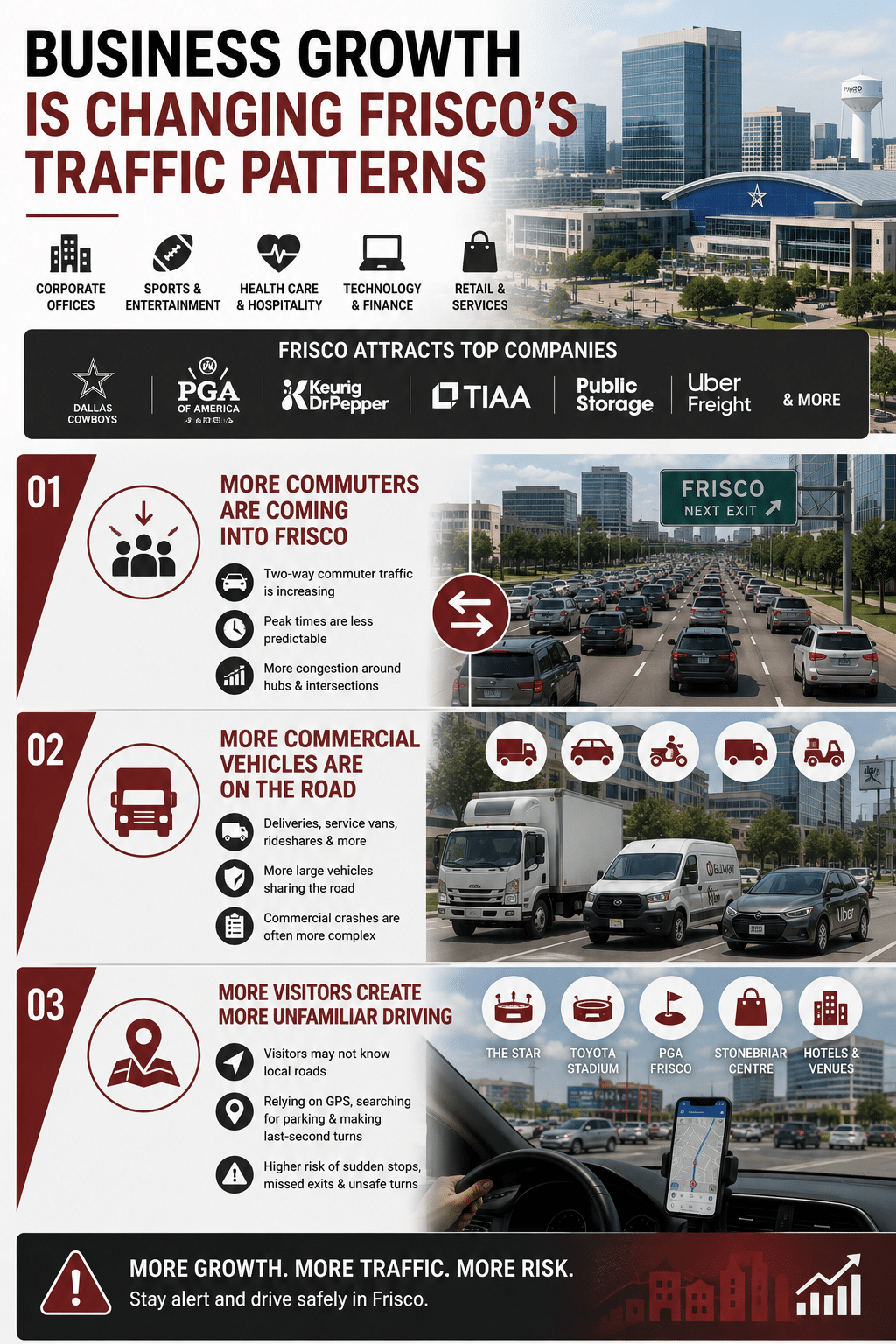
Frisco’s economic growth is not limited to housing. The city has become a destination for corporate headquarters, regional offices, sports organizations, entertainment developments, health care, hospitality, technology, finance, and retail.
Frisco Economic Development Corporation has promoted the city as a prime location for corporate and regional headquarters. Major names connected to Frisco’s business environment include the Dallas Cowboys, PGA of America, Keurig Dr Pepper, TIAA, Public Storage, Uber Freight, and many others.
This business growth changes traffic in several important ways.
More Commuters Are Coming Into Frisco
As Frisco attracts more corporate offices and commercial developments, traffic becomes two-directional. Frisco is no longer just a place where residents leave for work in Dallas or Plano. It is also a place where employees from across the region commute in.
That shift can increase congestion around employment hubs, mixed-use developments, parking structures, restaurants, and major intersections. It can also make peak travel times less predictable because traffic is spread across office hours, events, lunch traffic, evening entertainment, and weekend tourism.
More Commercial Vehicles Are on the Road
Business growth also brings more commercial traffic. Delivery trucks, rideshare drivers, food delivery vehicles, service vans, contractors, construction equipment, hotel shuttles, and corporate transportation vehicles all share the road with local families.
Commercial vehicle accidents can be more complex than ordinary passenger car crashes. If a delivery driver, contractor, or company vehicle causes a collision, the injury claim may involve employer liability, commercial insurance, vehicle maintenance records, delivery schedules, or driver training issues.
More Visitors Create More Unfamiliar Driving
Frisco’s entertainment and sports economy brings visitors who may not know local roads well. People coming to The Star, Toyota Stadium, PGA Frisco, Stonebriar Centre, Fields, or other major destinations may be relying on GPS, searching for parking, making last-second turns, or navigating unfamiliar intersections.
Unfamiliar drivers are more likely to brake suddenly, miss exits, drift between lanes, or make unsafe turns. In a busy growth market like Frisco, this can increase the risk of crashes near hotels, event venues, shopping centers, restaurants, and parking lots.
Construction Is a Natural Result of Growth
A city experiencing a 2,200% tax base boom does not stay physically the same. Roads are widened. Intersections are redesigned. Utilities are extended. New neighborhoods are built. Office towers rise. Retail centers open. Mixed-use districts expand. Entertainment projects create new destination traffic.
All of that construction can be positive for the city’s future, but it also creates short-term roadway hazards.
Construction Zones Reduce Margin for Error
Construction zones often involve lane shifts, temporary signs, cones, reduced shoulders, uneven pavement, and sudden slowdowns. Drivers who are distracted or speeding may not have enough time to react.
In Frisco, construction zones are especially challenging because they often appear near already-busy roads. When roadwork overlaps with commuter traffic, school traffic, or event traffic, crash risks increase.
Heavy Equipment Creates Additional Hazards
Large trucks and construction equipment may enter and exit work areas throughout the day. These vehicles have larger blind spots, slower acceleration, wider turns, and longer stopping distances. When they interact with regular traffic, collisions can be severe.
Changing Road Patterns Confuse Drivers
A driver who takes the same route every day may suddenly encounter a closed lane, temporary turn restriction, new signal timing, or unexpected detour. Confusion can lead to sudden braking, unsafe merging, or last-second lane changes.
For injury victims, construction-related crashes may require a deeper investigation. The responsible party may be another driver, a contractor, a construction company, a public agency, or a combination of parties.
The Roads Most Affected by Frisco’s Growth
Frisco’s growth is visible across the city, but certain roads carry much of the pressure.
Dallas North Tollway
The Dallas North Tollway is one of the most important corridors in Frisco. It connects the city to Plano, Addison, Dallas, Prosper, and the broader North Texas region. As Frisco continues to attract residents, workers, corporate offices, and visitors, traffic on and near the Tollway remains intense.
High-speed corridors tend to produce more serious crashes because the force of impact increases with speed. Rear-end collisions, chain-reaction crashes, side-swipe accidents, and sudden lane-change collisions can all become severe on fast-moving roads.
Preston Road
Preston Road serves local traffic, shopping traffic, school traffic, and commuter traffic. It includes numerous intersections, business entrances, restaurant driveways, retail centers, and neighborhood access points.
Frequent braking, turning, and merging can create crash risks, especially when drivers are distracted or impatient.
Main Street and Eldorado Parkway
Main Street and Eldorado Parkway carry east-west traffic through residential and commercial areas. As new development continues, these roads face increased pressure from local trips, school traffic, and retail activity.
Intersection crashes, red-light running, left-turn collisions, and rear-end accidents are common risks on roads with heavy stop-and-go traffic.
FM 423 and US 380
Growth in Frisco, Little Elm, Prosper, and nearby communities has placed added pressure on FM 423 and US 380. These corridors serve drivers moving between fast-growing communities. When regional growth outpaces roadway capacity, congestion and driver frustration can increase.
Why Economic Growth Can Lead to More Serious Accident Claims
When a city grows rapidly, car accident claims may become more complex. More parties may be involved. More insurance policies may apply. More evidence may need to be preserved.
Multiple Vehicles and Chain-Reaction Crashes
Heavy traffic increases the likelihood of multi-vehicle accidents. In a chain-reaction crash, each driver may tell a different story about what happened. Determining fault may require police reports, dashcam footage, vehicle damage analysis, witness statements, and crash reconstruction.
Commercial Insurance Issues
Business growth means more company vehicles and more drivers working while behind the wheel. If a crash involves a commercial vehicle, the insurance coverage may be higher, but the defense may also be more aggressive.
Companies and insurers may dispute whether the driver was on duty, whether the driver was an employee or contractor, or whether the company can be held responsible.
Premises and Parking Lot Liability
Growth also increases the number of crashes and injuries in parking lots, shopping centers, hotels, sports venues, and mixed-use developments. These incidents may involve negligent drivers, unsafe property design, poor lighting, lack of pedestrian protection, or inadequate traffic control.
More Pedestrian and Cyclist Exposure
As Frisco grows into a live-work-play city, more people walk between restaurants, offices, apartments, hotels, schools, entertainment venues, and parking areas. Pedestrians and cyclists are especially vulnerable in collisions because they have little protection from impact.
Growth Benefits Frisco, But Safety Must Keep Up
Frisco’s expansion has helped create jobs, build amenities, attract investment, and support a high quality of life. The goal is not to criticize growth. The goal is to recognize that roadway safety must grow with the city.
A larger tax base can help fund infrastructure, public safety, road improvements, traffic signals, pedestrian safety measures, and emergency response. But public investment alone cannot eliminate crash risks. Drivers must also adjust to the reality of a busier city.
That means slowing down, avoiding distractions, allowing more travel time, watching for pedestrians, staying patient in construction zones, and being especially cautious near schools and event venues.
What To Do After a Crash in a Fast-Growing Area Like Frisco
After a car accident in Frisco, the steps you take can affect your health and your injury claim.
First, call 911 if anyone is injured or if the crash creates a hazard. Request medical care if you have pain, dizziness, numbness, confusion, or visible injuries. Some serious injuries, including concussions and soft tissue injuries, may not be obvious right away.
Second, document the scene if you can do so safely. Take photos of vehicle damage, road conditions, traffic signs, construction zones, skid marks, debris, injuries, and nearby cameras. If the crash happened near a business, school, apartment complex, or construction site, video footage may exist.
Third, exchange information with the other driver, but avoid admitting fault. Even simple statements can be used against you later.
Fourth, be careful with insurance adjusters. The other driver’s insurer may contact you quickly and ask for a recorded statement. Before you give one, it may be wise to speak with a personal injury attorney.
How JML Injury Law Helps Frisco Accident Victims
JML Injury Law represents people injured in car accidents, truck accidents, pedestrian accidents, rideshare accidents, commercial vehicle crashes, and other serious injury cases throughout North Texas.
In a rapidly growing city like Frisco, a strong injury claim often requires more than basic paperwork. It may require investigating traffic patterns, identifying commercial insurance coverage, preserving video footage, reviewing police reports, collecting medical evidence, and proving how the injury has affected your life.
JML Injury Law helps injury victims pursue compensation for medical bills, lost income, pain and suffering, future treatment, reduced earning capacity, property damage, and other losses caused by negligence.
Frequently Asked Questions About Frisco Growth and Accident Risks
Why does Frisco’s tax base growth matter for traffic safety?
Tax base growth reflects a larger and more active city. More homes, businesses, offices, retail centers, and entertainment venues usually mean more vehicles, more pedestrians, more delivery drivers, and more construction. That increased activity can raise crash risks if roadway safety does not keep pace.
Did Frisco’s tax revenue really grow by 2,200%?
The Bloomberg coverage refers to Frisco’s tax base growing by more than 2,200%, not necessarily city tax revenue. Tax base growth means the taxable value supporting local government has expanded dramatically. Actual revenue depends on tax rates, exemptions, budgets, and other factors.
What types of accidents are more common in fast-growing cities?
Fast-growing cities often see more rear-end crashes, intersection accidents, construction zone collisions, pedestrian accidents, parking lot crashes, commercial vehicle accidents, and multi-vehicle crashes. These accidents are often tied to congestion, driver impatience, unfamiliar roads, and changing traffic patterns.
Can business growth make accident claims more complicated?
Yes. If a crash involves a delivery driver, company vehicle, rideshare driver, contractor, or commercial truck, the claim may involve multiple insurance policies and potential employer liability. These cases often require a more detailed investigation.
Should I contact a lawyer after a Frisco car accident?
If you were injured, needed medical care, missed work, or are being blamed for the crash, it is smart to speak with a personal injury attorney. A lawyer can help protect evidence, deal with insurance companies, and pursue compensation for your losses.
Frisco’s Boom Is Still Unfolding
Frisco’s 2,200% tax base boom is not just a financial headline. It is a sign of how dramatically the city has changed. Population growth, corporate relocation, residential development, entertainment projects, and rising property values have turned Frisco into one of the most dynamic cities in Texas.
That growth creates opportunity. It also creates responsibility.
As more people live, work, drive, shop, and visit Frisco, roadway safety must remain a priority. For drivers, that means staying alert and patient. For city planners, it means continuing to invest in infrastructure and safety. For injury victims, it means understanding that a crash in a fast-growing city may involve complex evidence, multiple parties, and serious long-term consequences.
JML Injury Law is here to help injured Texans understand their rights and move forward after a serious accident. Contact our firm today for a free consultation.