

Why School Zone Safety Matters in Frisco
Back-to-school season changes traffic patterns across Frisco almost overnight. Roads that felt manageable during the summer suddenly become crowded with buses, parent drop-off lines, student drivers, cyclists, pedestrians, crossing guards, and commuters trying to get through school traffic.
For parents, this creates a real safety concern. School zones are designed to protect children, but they can also become chaotic when drivers are rushed, distracted, impatient, or unfamiliar with campus traffic patterns.
Frisco Independent School District serves more than 60,000 students and employs thousands of staff members. That means school-related traffic is not limited to one or two campuses. It affects neighborhoods, major roads, intersections, and residential streets throughout the city.
TxDOT reported 877 traffic crashes in Texas school zones in 2025, a 12% increase from the prior year. The agency also reported 2,358 collisions involving school buses. Speeding and distracted driving were the most common contributing factors in those crashes.
For Frisco families, those numbers should be a reminder that school zone safety is not just about signs and flashing lights. It is about driver behavior, roadway design, visibility, timing, and accountability when a preventable crash causes injury.
Why Frisco School Zones Are Especially Busy
Frisco is a family-centered city with a large school-aged population. According to U.S. Census data, more than one-quarter of Frisco residents are under 18. That demographic reality creates major traffic volume around schools each morning and afternoon.
Parent Drop-Off and Pickup Lines
Many Frisco schools have long carpool lines before and after school. Drivers may wait in traffic, move slowly through campus loops, or attempt to enter and exit crowded parking areas. These conditions create risks for rear-end crashes, pedestrian accidents, and collisions involving vehicles backing out or turning unexpectedly.
Student Drivers
High school campuses bring another layer of risk. Teen drivers may be newly licensed, inexperienced in heavy traffic, or more vulnerable to distractions. Even responsible teen drivers may struggle with congested parking lots, crowded intersections, and hurried morning traffic.
Bus Stops and Residential Streets
School zone risk is not limited to school property. Children also gather at bus stops, walk through neighborhoods, cross residential streets, and exit buses near driveways or parked vehicles. Drivers who speed through neighborhoods or roll through stop signs can create serious danger before a child even reaches campus.
Major Roads Near Schools
Many Frisco schools are located near busy roads such as Eldorado Parkway, Main Street, Legacy Drive, Coit Road, Independence Parkway, Teel Parkway, Lebanon Road, Preston Road, and FM 423. When campus traffic connects with major commuter routes, the margin for error becomes smaller.
Common Causes of School Zone Accidents
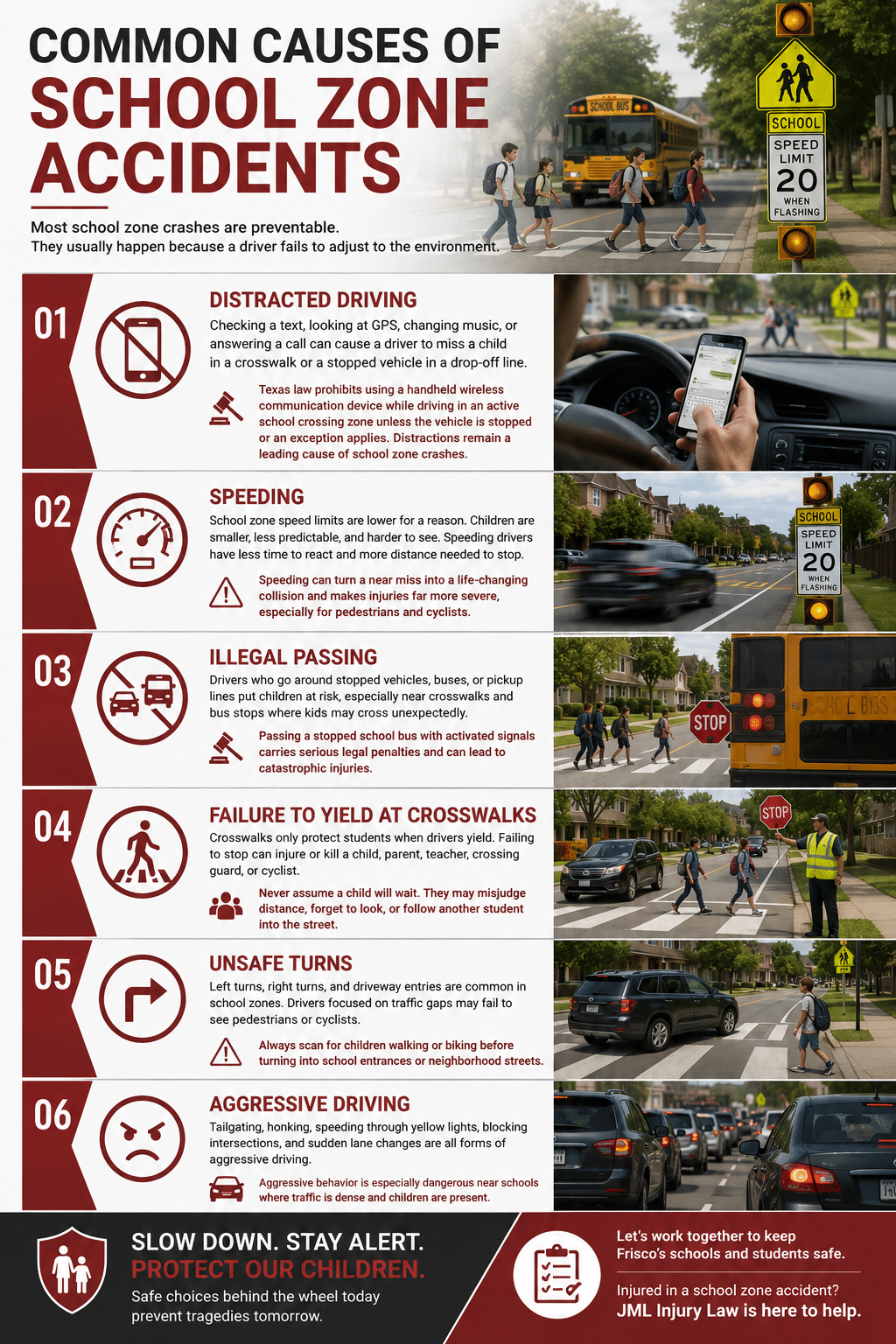
Most school zone crashes are preventable. They usually happen because a driver fails to adjust to the environment.
Distracted Driving
Distracted driving is one of the biggest threats in school zones. A driver checking a text, looking at GPS, changing music, or answering a call may fail to see a child entering a crosswalk or a vehicle stopping in a drop-off line.
Texas law prohibits using a handheld wireless communication device while driving in an active school crossing zone unless the vehicle is stopped or the use is allowed under a legal exception. Even with that law in place, distracted driving remains a major problem.
Speeding
School zone speed limits are lower for a reason. Children are smaller, less predictable, and harder to see than adults. A speeding driver has less time to react and needs more distance to stop.
Speeding can turn what might have been a near miss into a life-changing collision. It can also make injuries far more severe, especially when a pedestrian or cyclist is involved.
Illegal Passing
Drivers sometimes try to go around stopped vehicles, buses, or long pickup lines. This is especially dangerous near crosswalks and bus stops because children may be crossing in front of stopped traffic.
Passing a stopped school bus when its signals are activated can lead to serious legal consequences. More importantly, it can lead to catastrophic injuries.
Failure to Yield at Crosswalks
Crosswalks are one of the most important safety features in school zones, but they only work when drivers obey them. A driver who fails to yield may hit a child, parent, teacher, crossing guard, or cyclist.
Drivers should never assume that a child will wait. Children may misjudge distance, forget to look both ways, or follow another student into the street.
Unsafe Turns
School zones often involve frequent left turns, right turns, and driveway entries. A driver turning into a school entrance or neighborhood street may focus on finding a gap in traffic and fail to see a pedestrian or cyclist.
Aggressive Driving
Back-to-school traffic can frustrate drivers. Some tailgate, honk, speed through yellow lights, block intersections, or make sudden lane changes. Aggressive driving is especially dangerous near schools because traffic is dense and children may be nearby.
The Most Common School Zone Accident Scenarios
Child Hit in a Crosswalk
A crosswalk accident may happen when a driver fails to stop, turns without looking, or becomes distracted by another vehicle. These cases often require a careful investigation into visibility, traffic signals, crossing guard placement, driver speed, and witness accounts.
Rear-End Crash in a Drop-Off Line
Rear-end crashes are common in school traffic because vehicles stop frequently. A driver who is looking at a phone or following too closely may hit the car in front of them. These collisions can cause whiplash, concussions, back injuries, and injuries to children riding in the vehicle.
School Bus Collision
A crash involving a school bus can be complicated because multiple children may be involved, and liability may depend on the actions of the bus driver, another motorist, a school district employee, a contractor, or a third-party transportation provider.
Parking Lot Injury
School parking lots can become crowded and confusing. Vehicles may back out, children may walk between cars, and parents may stop unexpectedly. Parking lot crashes can injure pedestrians even at low speeds.
Bicycle or Scooter Accident
Many students bike or ride scooters to school. These children are vulnerable near driveways, intersections, and school entrances. Drivers should watch carefully for children who may be riding on sidewalks, crossing streets, or entering the road from behind parked vehicles.
Injuries Children Can Suffer in School Zone Crashes
Children can suffer serious injuries even in crashes that occur at lower speeds. Their bodies are still developing, and they may be less able to protect themselves during impact.
Common injuries include:
- Broken bones
- Head injuries
- Concussions
- Facial injuries
- Dental injuries
- Internal injuries
- Neck and back injuries
- Knee and shoulder injuries
- Road rash
- Emotional trauma
Some injuries may not be obvious immediately. A child may seem shaken but okay at the scene, only to develop symptoms later. Parents should watch for headaches, nausea, dizziness, confusion, mood changes, sleep problems, pain, limping, or reluctance to use an arm or leg.
Prompt medical evaluation is important for the child’s health and for documenting the connection between the crash and the injury.
What Parents Should Do After a School Zone Accident
Call 911 and Report the Crash
If a child, parent, driver, cyclist, or pedestrian is injured, call 911. A police report can provide important documentation, including driver information, witness names, location details, and preliminary findings.
Get Medical Care Right Away
Do not assume a child is fine because they are able to walk or talk after the crash. Some injuries take time to show symptoms. Medical records can also become critical evidence if an insurance company later disputes the claim.
Take Photos and Videos
If it is safe, document the scene. Take photos of the vehicles, crosswalks, traffic signs, flashing school zone lights, road markings, bus signals, skid marks, debris, injuries, and weather conditions.
Identify Witnesses
Parents, teachers, crossing guards, bus drivers, nearby homeowners, and other drivers may have seen what happened. Witness statements can be especially important if the at-fault driver denies responsibility.
Preserve Video Evidence
Many school zone crashes are captured by cameras. Possible sources include school security cameras, bus cameras, dashcams, doorbell cameras, nearby business cameras, and city traffic cameras. Video evidence may be erased quickly, so it is important to act fast.
Avoid Speaking Too Freely With Insurance Adjusters
Insurance companies may contact parents soon after a crash. Be careful. Adjusters may ask questions designed to minimize the claim or shift blame. Avoid recorded statements until you understand your rights.
Who May Be Liable for a Frisco School Zone Accident?
Liability depends on what caused the crash. Several parties may be responsible.
Negligent Drivers
Most school zone claims involve a driver who was speeding, distracted, impaired, aggressive, or failed to yield.
Commercial Drivers
If a delivery driver, contractor, rideshare driver, or service vehicle caused the crash while working, the claim may involve commercial insurance coverage or employer liability.
School Bus Operators
If a school bus driver caused the crash, liability may depend on whether the bus was operated by a school district, contractor, or other transportation provider.
Government Entities
If unsafe roadway design, broken signals, missing signs, or poor visibility contributed to the crash, a government entity may need to be evaluated. These claims have strict notice requirements and shorter deadlines, so parents should seek legal guidance quickly.
Other Third Parties
In some cases, liability may involve a vehicle manufacturer, maintenance company, property owner, construction contractor, or another third party.
Texas Law and School Zone Injury Claims
Texas injury claims are built around negligence. To recover compensation, the injured person generally must show that another party owed a duty of care, breached that duty, and caused damages.
In a school zone, drivers have a responsibility to use extra caution. That includes obeying posted speed limits, watching for children, yielding at crosswalks, stopping for school buses when required, and avoiding handheld phone use in active school crossing zones.
Texas also follows a modified comparative fault rule. If an injured person is found partially responsible, compensation may be reduced. If they are found more than 50% responsible, recovery may be barred. In child injury cases, insurance companies may try to blame parents or argue that a child darted into traffic. Strong evidence can help push back against those claims.
Compensation After a School Zone Accident
A school zone accident claim may include compensation for:
- Emergency medical treatment
- Hospital care
- Follow-up appointments
- Physical therapy
- Specialist care
- Future medical needs
- Pain and suffering
- Emotional distress
- Scarring or disfigurement
- Parent wage loss related to caregiving
- Out-of-pocket expenses
When a child is injured, it is especially important to consider future damages. Some injuries affect growth, development, mobility, school participation, sports, sleep, emotional health, or long-term quality of life.
Safety Tips for Frisco Parents and Drivers
School zone safety requires effort from everyone.
Parents should teach children to use sidewalks, cross only at crosswalks, obey crossing guards, make eye contact with drivers, avoid distractions, and never run between parked cars.
Drivers should slow down before entering school zones, put phones away, watch for children near sidewalks and bus stops, stop for pedestrians, follow campus drop-off rules, and give themselves extra time during morning and afternoon traffic.
A few extra minutes of patience can prevent a lifetime of consequences.
Frequently Asked Questions About Frisco School Zone Accidents
What should I do if my child was hit near a school in Frisco?
Call 911, get medical care, document the scene, identify witnesses, and preserve any available video evidence. Then speak with a personal injury attorney before dealing with the insurance company.
Are school zone accident cases different from other car accident cases?
Yes. These cases may involve children, school buses, crossing guards, school district policies, traffic control devices, government entities, or campus safety procedures. The evidence can be more complex than a standard two-car crash.
Can a driver be liable even if my child was outside the marked school zone?
Yes. Drivers still have a duty to use reasonable care, especially near children, schools, crosswalks, and bus stops. Liability depends on the facts, including speed, visibility, driver attention, and road conditions.
What if the insurance company blames my child?
Insurance companies may try to shift blame, but children are treated differently than adults in many negligence analyses. Evidence such as witness statements, video footage, crossing guard testimony, and crash reconstruction can help protect the claim.
JML Injury Law Helps Families After School Zone Accidents
School zone accidents can be frightening, especially when a child is hurt. Parents are often left trying to manage medical appointments, insurance calls, missed work, school absences, and uncertainty about what happens next.
JML Injury Law helps injured families understand their options after serious accidents in Frisco and throughout North Texas. A legal claim can help protect a child’s future by pursuing compensation for medical care, pain and suffering, long-term needs, and other losses caused by a negligent driver or responsible party.
As Frisco continues to grow, school zone safety will remain an important issue for families, schools, and drivers. Every child deserves to get to school and back home safely. When someone’s negligence prevents that from happening, families have the right to seek accountability.