


Frisco’s Growth Is Changing the Way People Drive
Frisco has become one of the most recognizable growth stories in North Texas. What was once a smaller suburban community has turned into a major destination for families, professionals, corporate offices, schools, sports venues, shopping centers, and new residential development. That growth has brought tremendous opportunity, but it has also created a serious roadway safety concern.
According to U.S. Census estimates, Frisco’s population reached 236,955 in 2025. That represents an 18.2% increase from the city’s 2020 estimate base. In practical terms, Frisco added tens of thousands of residents in just a few years, and each new household adds daily trips to roads that are already busy.
More people means more vehicles. More vehicles means more congestion, more conflict points, more distracted driving, and more chances for crashes. For injury victims, this trend matters because many Frisco car accidents are not random. They are often the predictable result of traffic growth, construction, road design challenges, distracted driving, and aggressive commuter behavior.
Population Growth Means More Daily Vehicle Trips
A growing population does not just increase the number of cars parked in driveways. It increases the number of trips happening every day across the city.
Frisco residents drive to work, take children to school, visit grocery stores, commute to nearby cities, attend sports events, pick up food, meet friends, and run errands throughout the day. Many households have two or more vehicles. Some families have teen drivers. Others rely on delivery vehicles, rideshare drivers, contractors, and service providers who move through Frisco neighborhoods daily.
This creates a compounding effect. A single new subdivision does not simply add residents. It adds morning commuter traffic, afternoon school pickup traffic, weekend shopping traffic, delivery traffic, landscaping trucks, home service vehicles, and visitors.
Frisco’s average commute time is nearly half an hour, which means many residents spend a significant amount of time on the road each week. The more time drivers spend in traffic, the more likely they are to encounter dangerous situations, including sudden stops, unsafe lane changes, speeding drivers, and distracted motorists.
The Roads Carrying the Most Pressure in Frisco
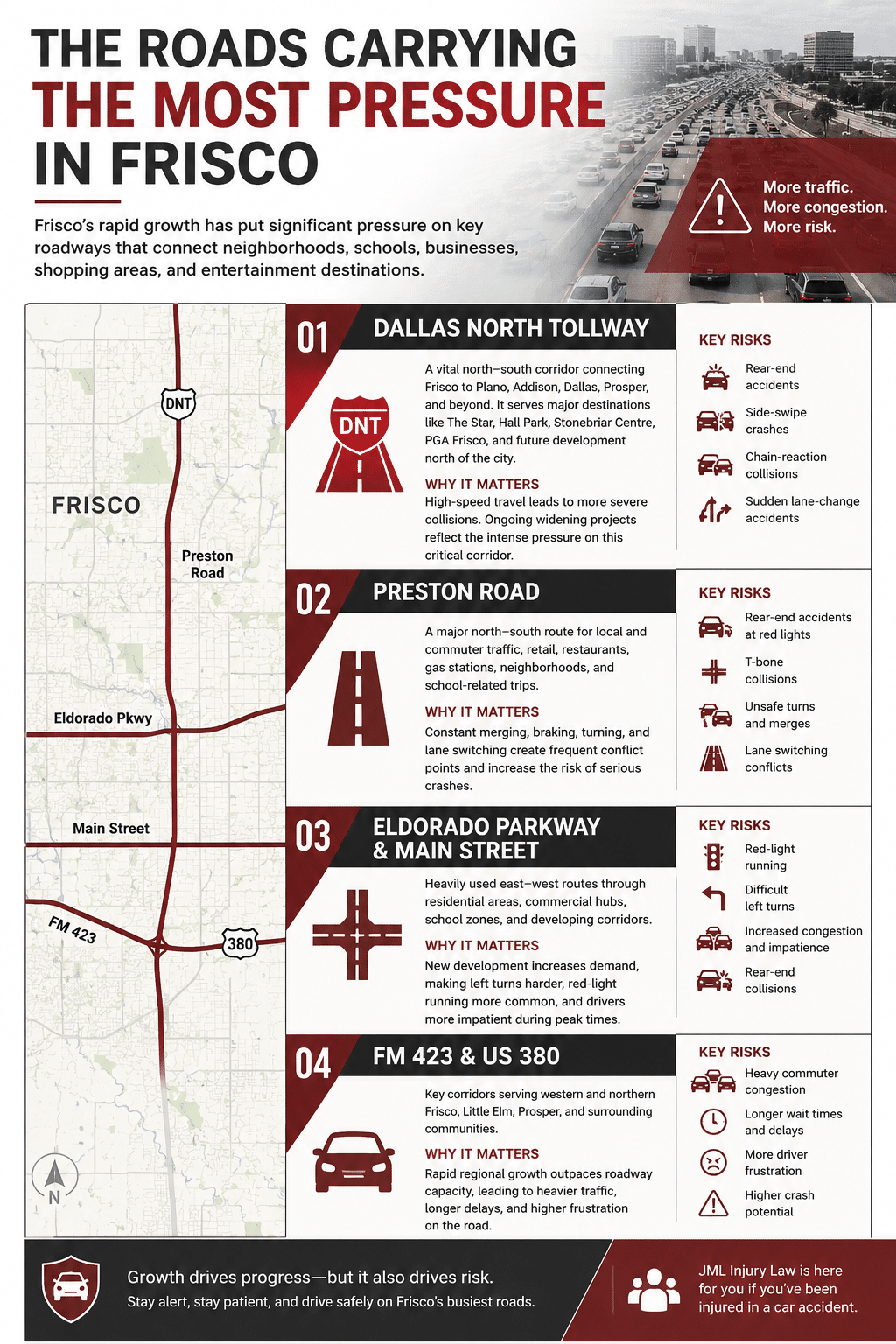
Frisco’s traffic risks are especially visible on major roads that connect neighborhoods, schools, businesses, shopping areas, and entertainment destinations.
Dallas North Tollway
The Dallas North Tollway is one of the most important transportation corridors in Frisco. It connects drivers to Plano, Addison, Dallas, Prosper, and surrounding communities. It also serves major destinations near The Star, Hall Park, Stonebriar Centre, PGA Frisco, and future development north of the city.
High-speed corridors like the Tollway tend to produce more serious collisions because crashes happen at higher speeds. Rear-end accidents, side-swipe crashes, chain-reaction collisions, and sudden lane-change accidents can all become severe when vehicles are traveling at highway speeds.
The North Texas Tollway Authority and the City of Frisco have widened portions of the Dallas North Tollway to respond to population growth and mobility demands. That type of project is necessary, but it also shows how much pressure the roadway system is under.
Preston Road
Preston Road is another major north-south corridor that handles local traffic, commuter traffic, shopping traffic, and school-related trips. Drivers turning into retail centers, restaurants, gas stations, neighborhoods, and side streets create frequent conflict points.
The danger on Preston Road often comes from constant merging, braking, turning, and lane switching. Even a brief distraction can lead to a rear-end crash at a red light or a T-bone collision when a driver misjudges an opening.
Eldorado Parkway and Main Street
Eldorado Parkway and Main Street are heavily used east-west routes in Frisco. Both roads carry drivers through residential areas, commercial areas, school zones, and developing corridors.
As new housing and retail centers continue opening, these roads experience greater demand. Increased traffic volume can make left turns harder, increase red-light running risks, and cause drivers to become impatient during peak travel times.
FM 423 and US 380
Growth in western Frisco, northern Frisco, Little Elm, Prosper, and nearby communities has increased pressure on FM 423 and US 380. These corridors often carry commuters who are moving between rapidly developing areas. When regional growth outpaces roadway capacity, drivers experience heavier traffic, longer waits, and more frustration.
Why Growth Increases Crash Risk
Population growth does not automatically cause crashes. The problem is the way growth changes traffic conditions.
More Vehicles in the Same Space
When more cars use the same roads, drivers have less room for error. A driver who looks down at a phone for two seconds may have had time to recover on an empty road. In Frisco traffic, that same mistake can cause a rear-end collision.
More Intersections and Turning Movements
Intersections are among the most dangerous places on Texas roads. TxDOT reported that more than 1,000 people were killed in crashes occurring in or related to intersections in 2024. In a growing city like Frisco, intersection risks increase as more drivers turn into neighborhoods, shopping centers, schools, offices, and event venues.
More Construction Zones
Frisco’s growth requires roadway expansion, utility work, new developments, and infrastructure improvements. Construction zones change normal driving patterns. Lanes narrow. Signs move. Traffic backs up. Drivers must react quickly to cones, equipment, lane shifts, and workers.
Construction-related congestion can lead to rear-end crashes, side-swipe collisions, and sudden merging accidents. In some cases, construction companies, contractors, or public entities may become part of the liability analysis if unsafe conditions contributed to the crash.
More Out-of-Town Drivers
Frisco is no longer just a residential suburb. It is a regional destination. Visitors come to The Star, Toyota Stadium, PGA Frisco, Stonebriar Centre, Riders Field, Comerica Center, and other locations.
Out-of-town drivers may be unfamiliar with Frisco’s roads, turning lanes, parking layouts, construction zones, and traffic patterns. Confused drivers are more likely to brake suddenly, drift across lanes, miss exits, or make unsafe turns.
The Role of Distracted Driving in a Fast-Growing City
Distracted driving is one of the most common and preventable causes of car accidents. In 2024, TxDOT reported 380 traffic deaths involving distracted driving statewide.
In Frisco, distractions are especially dangerous because traffic can change quickly. A driver may be moving at full speed one moment and approaching stopped traffic the next. Common distractions include texting, GPS navigation, phone calls, eating, adjusting music, checking notifications, or looking at children in the back seat.
Frisco’s growth also means many drivers rely heavily on navigation apps. While GPS can help drivers move through unfamiliar areas, it can also create risk when drivers look down at the screen, make sudden turns, or change lanes at the last second.
Growth Also Brings More Commercial and Delivery Traffic
Residential growth has changed the makeup of local traffic. Frisco neighborhoods now see regular deliveries from Amazon, FedEx, UPS, USPS, grocery services, food delivery apps, furniture companies, contractors, landscapers, and home service providers.
Delivery drivers often operate under time pressure. They may make frequent stops, reverse out of driveways, pull over near parked cars, block lanes, or look down at delivery instructions. These behaviors can increase the risk of neighborhood crashes, pedestrian accidents, and collisions involving children, cyclists, or parked vehicles.
Commercial traffic can also complicate injury claims. If a driver was working at the time of the crash, the claim may involve an employer, a delivery platform, a commercial insurance policy, or multiple layers of coverage.
Common Types of Car Accidents in Frisco
Rear-End Collisions
Rear-end crashes are common in stop-and-go traffic. They often happen near traffic lights, construction zones, school pickup lines, and congested commuter routes. Even low-speed rear-end crashes can cause neck injuries, back injuries, concussions, and shoulder injuries.
Intersection Accidents
Intersection crashes may involve red-light running, failure to yield, unsafe left turns, or distracted driving. These crashes can be especially dangerous because vehicles often strike each other at angles, exposing occupants to side-impact forces.
Multi-Vehicle Accidents
Heavy traffic increases the risk of chain-reaction crashes. One sudden stop on the Dallas North Tollway or Preston Road can trigger multiple collisions if drivers are following too closely.
Pedestrian and Bicycle Accidents
As Frisco becomes more active and walkable in certain areas, pedestrian and cyclist risks increase. Shopping centers, mixed-use developments, parks, school zones, and event venues can all bring foot traffic close to moving vehicles.
Parking Lot Accidents
Frisco’s retail and entertainment growth also increases parking lot crashes. These collisions may happen at malls, grocery stores, restaurants, sports venues, and apartment complexes. While some parking lot crashes are minor, others can seriously injure pedestrians, children, and cyclists.
Why Car Accident Claims Can Be More Complicated in Frisco
A car accident claim in a fast-growing area can involve more than two drivers arguing over fault. The evidence may include traffic camera footage, dashcam video, rideshare records, delivery app data, commercial vehicle records, witness statements, crash reports, and nearby business surveillance footage.
In some cases, liability may involve:
- A negligent driver
- A commercial vehicle company
- A rideshare driver
- A delivery driver
- A construction contractor
- A vehicle owner
- A government entity responsible for unsafe road conditions
- Multiple insurance companies
Texas uses a proportionate responsibility system. If an injured person is found partially at fault, their compensation may be reduced. If they are found more than 50% responsible, they may be barred from recovery. That is why evidence matters so much after a crash.
What To Do After a Car Accident in Frisco
After a crash, the first priority is safety. Call 911 if anyone is hurt or if the crash is blocking traffic. Move to a safe location if possible, but avoid leaving the scene. Request medical attention if you have pain, dizziness, confusion, numbness, or signs of injury.
Take photos and videos of the vehicles, road conditions, traffic signals, skid marks, debris, visible injuries, construction zones, and nearby businesses that may have cameras. Exchange information with the other driver, but avoid admitting fault or speculating about what happened.
It is also important to seek medical care quickly. Insurance companies often argue that delayed treatment means the injuries were not serious or were unrelated to the crash. A medical record can help connect the collision to the injuries.
Before giving a recorded statement to the other driver’s insurance company, consider speaking with a personal injury attorney. Insurance adjusters may sound helpful, but their job is to limit the company’s financial exposure.
How JML Injury Law Helps Frisco Crash Victims
JML Injury Law helps injured Texans understand their rights after serious accidents. In a growing city like Frisco, car accident cases often require a detailed investigation into traffic conditions, driver behavior, insurance coverage, medical records, and long-term damages.
A personal injury claim may seek compensation for emergency care, follow-up treatment, lost income, reduced earning capacity, pain and suffering, property damage, and future medical needs. The value of a claim depends on the severity of the injuries, available insurance coverage, liability evidence, and the long-term impact on the victim’s life.
Frequently Asked Questions About Frisco Car Accidents
Why are there more car accidents in Frisco?
Frisco’s rapid population growth has increased daily traffic, congestion, construction, school traffic, and commercial vehicle activity. More vehicles on the road create more opportunities for driver mistakes, especially at intersections and during peak commute times.
What roads in Frisco have higher crash risks?
Major corridors such as Dallas North Tollway, Preston Road, Eldorado Parkway, Main Street, FM 423, and US 380 often carry heavy traffic. Crash risk can increase near intersections, construction zones, shopping centers, schools, and event venues.
Can I recover compensation if I was partly at fault?
Possibly. Texas follows a modified comparative fault rule. If you are 50% or less responsible, your compensation may be reduced by your percentage of fault. If you are more than 50% responsible, you generally cannot recover compensation.
Should I call a lawyer after a Frisco car accident?
If you were injured, missed work, needed medical care, or are being blamed for the crash, speaking with an attorney can help protect your claim. A lawyer can investigate the crash, handle insurance communications, and help pursue full compensation.
Frisco’s Growth Is Not Slowing Down
Frisco’s population growth has brought new opportunity, new businesses, and new development. It has also brought heavier traffic and more complicated roadway risks.
As the city continues expanding, drivers must remain alert, patient, and cautious. But even careful drivers can be injured by someone else’s negligence. When a crash happens, the right evidence, medical care, and legal guidance can make a major difference in the outcome of a claim.
For injured drivers, passengers, pedestrians, and families, understanding the connection between Frisco’s growth and rising crash risks is the first step toward protecting their health, finances, and legal rights.